
In Revelation 21:1, the apostle John writes. ‘Then I saw a new heaven and a new earth. The first heaven and the first earth had passed away.’ This striking vision has stirred the hearts and minds of believers for centuries. It points to the final fulfillment of God’s redemptive work. But what does John mean by ‘a new earth’? Across church history and theological traditions, five main views have emerged to explain this prophetic promise. Some believe it means the total annihilation and replacement of the current earth. Others see it as a purified and renewed version of the same creation. Still others interpret it symbolically, covenantally, or in light of the distinction between the intermediate and final state. Each view offers a unique lens through which to grasp the depth and glory of God’s eternal plan. Individually, they remind us that whether by renewal, replacement, or representation, God’s promise is sure. The brokenness of the present will end. There will be a future where He dwells fully with His people. This future is marked by righteousness and peace.
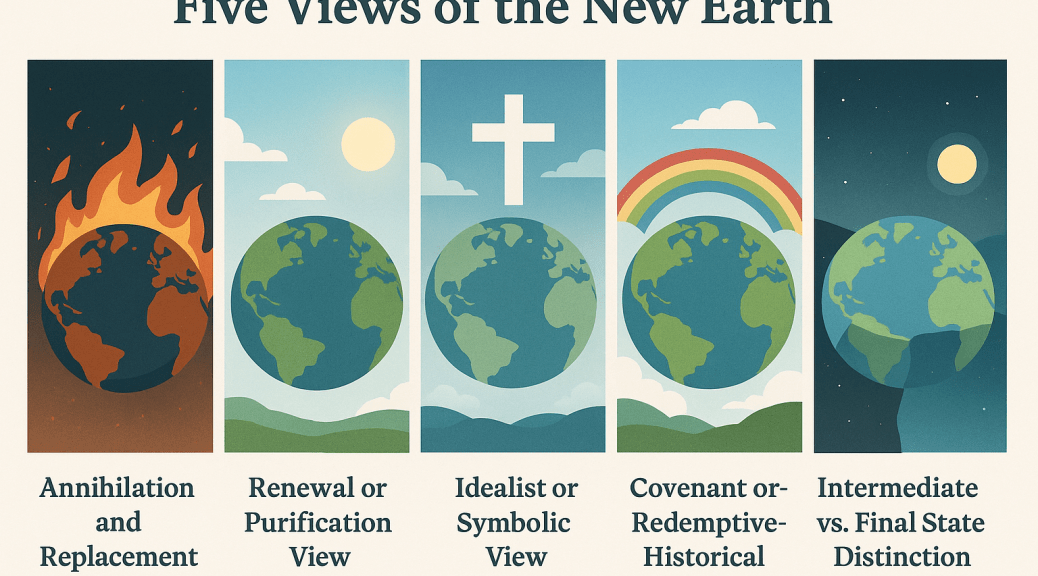
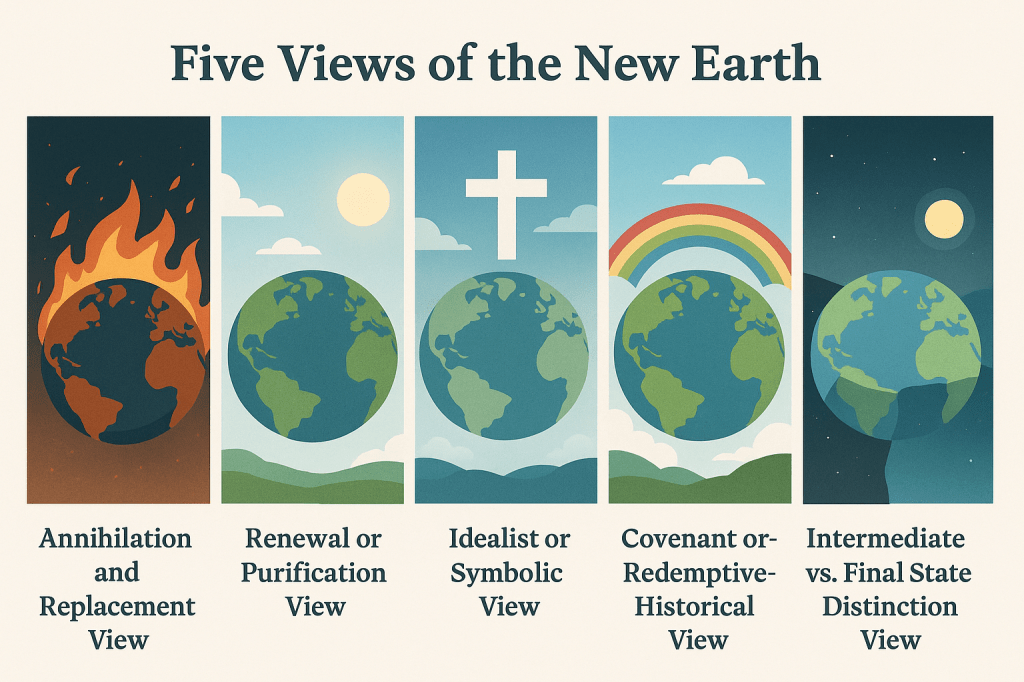
1. Annihilation and Replacement View (Cataclysmic Destruction)
- View: The current earth and heavens will be completely destroyed and replaced with a brand-new creation.
- Support:
- Revelation 21:1 – “the first earth had passed away.”
- 2 Peter 3:10 – “…the earth and everything in it will be laid bare” or “burned up” (some translations).
- Implication: The “new earth” will be a totally different realm, not a restoration but a brand-new universe.
2. Renewal or Purification View (Continuity View)
- View: The current earth will be purified. It will be transformed and renewed. This process is much like the resurrection of the body (same body, glorified state).
- Support:
- Romans 8:19–23 – Creation groans for liberation and will be set free from decay, not destroyed.
- Matthew 19:28 – Jesus speaks of the “renewal of all things.”
- The analogy to Jesus’ resurrection: He rose with the same body, but glorified.
- Implication: The “new earth” will be this earth, redeemed and glorified, in continuity with the old.
3. Idealist or Symbolic View
- View: The new heaven and new earth are symbolic of the full realization of God’s kingdom. It is more about spiritual realities than physical geography.
- Support:
- Revelation is apocalyptic literature, rich in symbols.
- “Heaven and earth” could symbolize the entire created order now under God’s complete rule.
- Implication: The focus is on the relationship and presence of God, not on the material makeup of the cosmos.
4. Covenant or Redemptive-Historical View
- View: “New heaven and new earth” refers to the new covenant order, not to the physical universe. This view is held by some preterists and covenant theologians.
- Support:
- Isaiah 65:17–25 uses “new heavens and new earth” language to describe restored Israel.
- 2 Corinthians 5:17 – The believer is a “new creation,” yet physically the same.
- Implication: It’s about a radical change in redemptive history, not necessarily a physical or spatial change.
5. Intermediate vs. Final State Distinction View
- View: Some theologians emphasize the difference between:
- Intermediate heaven (where believers go now when they die), and
- Final new heaven and new earth (the eternal state after resurrection).
- This is not totally considered a “view” on the earth’s destruction. However, it helps frame where and how these transformations take place.
Summary Table:
| View | Earth’s Fate | Key Scripture | Implication |
|---|---|---|---|
| Annihilation | Totally destroyed and replaced | Rev. 21:1, 2 Pet. 3:10 | Brand-new universe |
| Renewal | Purified and transformed | Rom. 8:21, Matt. 19:28 | Restored creation |
| Symbolic/Idealist | Figurative language | Rev. 21:1–3 | Represents spiritual perfection |
| Covenant View | New redemptive order | Isa. 65:17, 2 Cor. 5:17 | New relationship, not geography |
| Intermediate/Final State | Earth becomes final dwelling | Rev. 21–22 | God’s presence with glorified humanity |
Greek Words for “New”: Kainos vs. Neos
The New Testament uses two Greek words that are commonly translated as “new” in English:
1. Neos (νέος) – New in time or origin
- Meaning: Refers to something that is new in chronological order, recent, young, or newly created.
- Usage: Often describes something that never existed before or that is younger or more recent than what came before.
- Examples:
- Luke 5:37 – “No one pours new (neos) wine into old wineskins.”
- Colossians 3:10 – “…put on the new (neos) self…”
- Implication: If neos were used in Revelation 21:1, it might suggest a completely brand-new earth—one that replaces the old entirely with no continuity.
2. Kainos (καινός) – New in quality, nature, or condition
- Meaning: Refers to something that is renewed or transformed, new in kind, quality, or superior to the old, though it may have existed before.
- Usage: Emphasizes renewal, transformation, and restoration.
- Examples:
- 2 Corinthians 5:17 – “If anyone is in Christ, he is a new (kainos) creation.”
- Revelation 21:1 – “Then I saw a new (kainos) heaven and a new (kainos) earth…”
- Implication: The use of kainos in Revelation 21:1 suggests that the new earth may be the present earth made new—transformed, purified, and glorified, rather than annihilated and replaced.
Why This Matters Theologically
- For the Renewal View:
- Kainos supports the idea that God will redeem and transform creation, not destroy it.
- Aligns with Romans 8:19–22, where creation is said to be longing for redemption, not elimination.
- Mirrors the resurrection of the body—the same body, but glorified (Philippians 3:21).
- For the Replacement View:
- Some still argue that even if kainos is used, the transformation is so radical that it functions like a total replacement.
- They may also pair kainos with the image in 2 Peter 3:10, which speaks of the heavens and earth being “burned up.”
Summary of Kainos vs. Neos in Revelation 21:1
| Greek Word | Meaning | Focus | Revelation 21:1 Usage | Implication |
|---|---|---|---|---|
| Neos | New in time, recent | Chronology | Not used | Would suggest total replacement |
| Kainos | New in nature or quality | Transformation | Used | Suggests renewal or glorification of existing creation |
The use of kainos in Revelation 21:1 provides a strong linguistic case for the continuity view—that God’s plan is not to abandon or erase creation, but to renew it, glorify it, and dwell with His people in it forever. This reflects the overarching biblical narrative: God makes all things new—not all new things.
Christians may interpret the nature of the new earth differently. Some view it as a completely new creation, while others see it as a renewed version of the present world. For some, it is a symbolic expression of God’s eternal kingdom. However, what unites us is far greater than what divides us. Revelation 21:1 assures us that God is moving history toward a glorious culmination. At that time, all things will be made right. His presence will dwell fully among His people. In the end, the promise of a new heaven and new earth is not just about the future geography of the cosmos. It is also about the fulfillment of God’s redemptive love. May this hope stir in us a deeper longing for His return. May it also stir a greater faith in His promises. We are called to be a more faithful witness in the world we live in today.

