
Revelation Unveiled: A Fourfold Theological Analysis
- Main Context
- The Christ (Ch. 1)
- The Churches (Ch. 2-3)
- Similarities
- Differences
- 📊 Quick Comparison Table
- The Court of Heaven (Ch. 4-5)
- The Catastrophe (Ch. 6-18)
- The Conquest of the Rider (Seal Judgments) (6:1-17)
- The Cry of the Martyrs (7:1-17)
- The Cataclysms of the Trumpets (8:1-11:19)
- The Conflict with the Dragon (12:1-17)
- The Corruption of the Beast (13:1-18)
- The Call of the Angels (14:1-20)
- The Cups of Wrath (Bowl Judgments) (15:1-16:21)
- The Collapse of Babylon (17:1-18:24)
- Discussion Questions for Revelation 6-18
- Multiple Choice Quiz
- The Coming of Christ (Ch. 19)
- The Consummation by Christ (Ch. 20)
- The Celestial City (Ch. 21-22)
- ENROLL IN OUR SHORT COURSES
About our Professor
Dr. Rhoderick de Vera D.Min.
Pastor | Theologian | Missionary | Educator | Founder of Mobile Bible School
Dr. Rhoderick Alcaide De Vera is a dedicated pastor, theologian, and missionary with a passion for equipping believers for kingdom work. As the founder of Mobile Bible School, he has pioneered flexible, self-paced theological education. This has impacted present and future church leaders in the Philippines and abroad.

COURSE SYLLABUS
CLICK TO READ SYLLABUS
- Doctorate-Level Course: Parallel Study of Revelation in Four Different Perspectives
- Schedule: Four online sessions through ZOOM (every other week, 3 hours each, 8:00-10:00 PM) Starting on March 28, 2025
- Asynchronous Learning: 8 hours (reading, video lessons, self-paced engagement, practical application)
- Total Course Hours: 20 hours
Course Description: - This course provides an in-depth study of the Book of Revelation. It explores the four primary interpretive perspectives: Preterist, Historicist, Futurist, and Idealist. We will examine how each approach interprets key events, symbols, and prophecies while engaging in critical discussions and practical application.
Course Objectives - A. Cognitive (Head – Learning & Understanding)
– Comprehend the historical and theological context of Revelation.
– Compare the Preterist, Historicist, Futurist, and Idealist interpretations.
– Critique scholarly and theological debates surrounding Revelation. - B. Affective (Heart – Emotion & Appreciation)
– Cultivate a deep appreciation for Revelation’s relevance to faith and history.
– Connect the study of Revelation to personal spiritual growth.
– Commit to respectful and informed theological discussion. - C. Volitional (Hands – Action & Application)
– Communicate Revelation’s themes effectively in teaching and ministry settings.
– Contribute to academic and theological discourse through essays and discussions.
– Convey a well-informed, personal theological stance on Revelation.
Course Outline & Schedule - Session 1: Introduction to Revelation & The Christ (Chapter 1)
Authorship, Date, and Audience
Key Themes & Purpose of Revelation
The Four Interpretative Approaches (Preterist, Historicist, Futurist, Idealist)
The Revelation of Christ (His Character, Commission, Countenance, and Command) - Session 2: The Churches & The Court of Heaven (Chapters 2-5)
Messages to the Seven Churches: Praise, Rebuke, and Promises
The Throne Room of God and Worship in Heaven
Christ as the Worthy Redeemer - Session 3: The Catastrophe – Judgments & Tribulation (Chapters 6-18)
The Seal, Trumpet, and Bowl Judgments
The Antichrist, the Beast, and Babylon
Theological Implications of Judgment and Justice - Session 4: The Coming of Christ, The Consummation, and The Celestial City (Chapters 19-22)
The Second Coming and Final Victory
The Great White Throne Judgment
The New Heaven, New Earth, and Eternal Glory
Assessment & Grading – Assessment Component - Weight Participation (Self-Paced Engagement) – Commenting on uploaded video lessons or website discussions
15% - Short Essays (At least 200 words each) – Reflective analysis on Revelation topics
20% - Assignments – Thematic responses, interpretation comparisons, and application exercises
20% - Quizzes & Exams – Multiple-choice, short-answer, and essay-based assessments
30% - Final Project or Teaching Application – Teaching a lesson, writing a theological article, or leading a Bible study
15%
INTRODUCTION TO THE BOOK OF REVELATION
Main Context
The Book of Revelation is the final book of the Bible. It is a prophetic and apocalyptic text filled with vivid imagery. It includes divine revelations and eschatological themes. It serves as a message of hope. Additionally, it acts as a warning. It portrays the ultimate triumph of Christ over evil. It also illustrates the fulfillment of God’s redemptive plan.
Revelation stands unique among biblical books due to its extensive use of symbolism, visions, and heavenly scenes. It combines Old Testament prophecy with New Testament fulfillment and future realities. This combination makes it essential for theological study. This is particularly true when viewed through different interpretative lenses: Preterism, Historicism, Futurism, and Idealism.
Dr. Rhoderick de Vera explored the concept of Eschatology through 14 distinct perspectives. Before starting the full Eschatology Course video series, it is important to understand the four interpretive views of Revelation. Knowing their key proponents is also essential.
Watch this video lesson first to learn more about these four interpretive views!
Authorship and Date of Writing
Who wrote Revelation?
The Book of Revelation is traditionally attributed to John the Apostle, who is also known as John the Beloved. He is the same disciple who wrote the Gospel of John and the Epistles of John. The author identifies himself simply as “John” (Revelation 1:1, 1:4, 1:9). Early church fathers such as Justin Martyr, Irenaeus, and Tertullian affirmed this identification.
When was Revelation written?
Scholars propose two primary dates for its writing:
- Early Date (A.D. 64-68) – During the reign of Nero, before the destruction of Jerusalem (A.D. 70). This date supports the Preterist interpretation.
- Later Date (A.D. 95-96) – During the reign of Domitian, when John was exiled to Patmos (Revelation 1:9). This is the more widely accepted view and supports the Futurist interpretation.
Speaker and Audience
Who is the speaker?
The primary speaker in Revelation is Jesus Christ Himself (Revelation 1:1, 1:8, 1:17-18). He reveals divine mysteries through visions given to John. The book also contains messages from angels, elders, and heavenly beings.
To whom or for whom was Revelation written?
Revelation was originally addressed to the seven churches in Asia Minor (modern-day Turkey):
The Seven Churches in the book of Revelation
- Ephesus (Revelation 2:1-7)
- Smyrna (2:8-11)
- Laodicea (3:14-22)
- Pergamum (2:12-17)
- Thyatira (2:18-29)
- Sardis (3:1-6)
- Philadelphia (3:7-13)
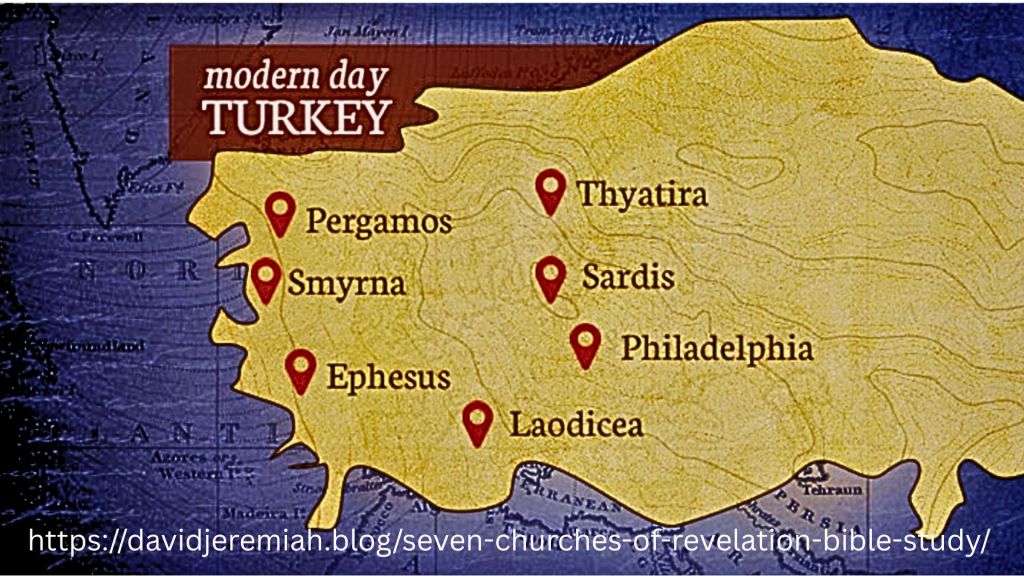
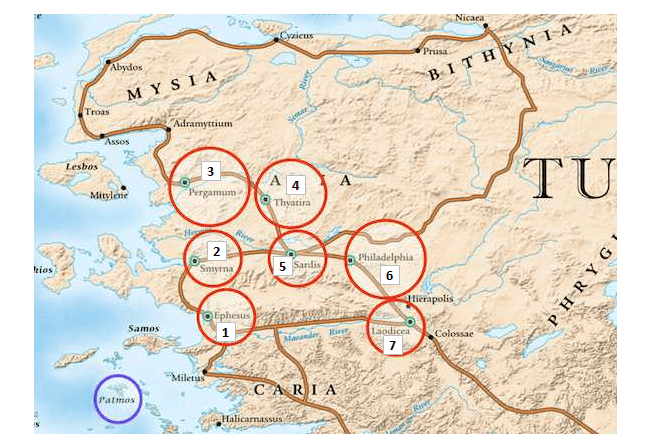
The message was directed to these first-century churches. However, the themes and prophecies in Revelation extend to all believers throughout history. These are especially relevant concerning the end times, spiritual perseverance, and God’s final judgment.
Who is Jesus in the Book of Revelation?
Revelation presents Jesus Christ in His full divine authority as: (Click to read more)
- The Alpha and Omega – The eternal, sovereign One (Revelation 1:8, 22:13).
- The Faithful Witness – The perfect revelation of God (1:5).
- The Firstborn from the Dead – His resurrection guarantees victory (1:5).
- The Ruler of Kings on Earth – Supreme over all earthly powers (1:5).
- The Son of Man – The majestic, glorified Christ (1:13-16).
- The Lion of Judah – The conquering King (5:5).
- The Lamb Who Was Slain – The sacrificial Redeemer (5:6-14).
- The Bridegroom – Coming for His Bride, the Church (19:7-9).
- The King of Kings and Lord of Lords – The victorious returning King (19:11-16).
- The Light of the New Jerusalem – The eternal presence of God (21:23).
The Central Verse of Revelation
While many key verses encapsulate its message, Revelation 1:7 stands out as the main theme of the book:
“Behold, He is coming with clouds, and every eye will see Him, even they who pierced Him. And all the tribes of the earth will mourn because of Him. Even so, Amen.” (Revelation 1:7, NKJV)
This verse captures the essence of Revelation: the certainty of Christ’s return. It highlights the global recognition of His coming. Additionally, it describes the response of humanity to His judgment and reign.
MODULE 1
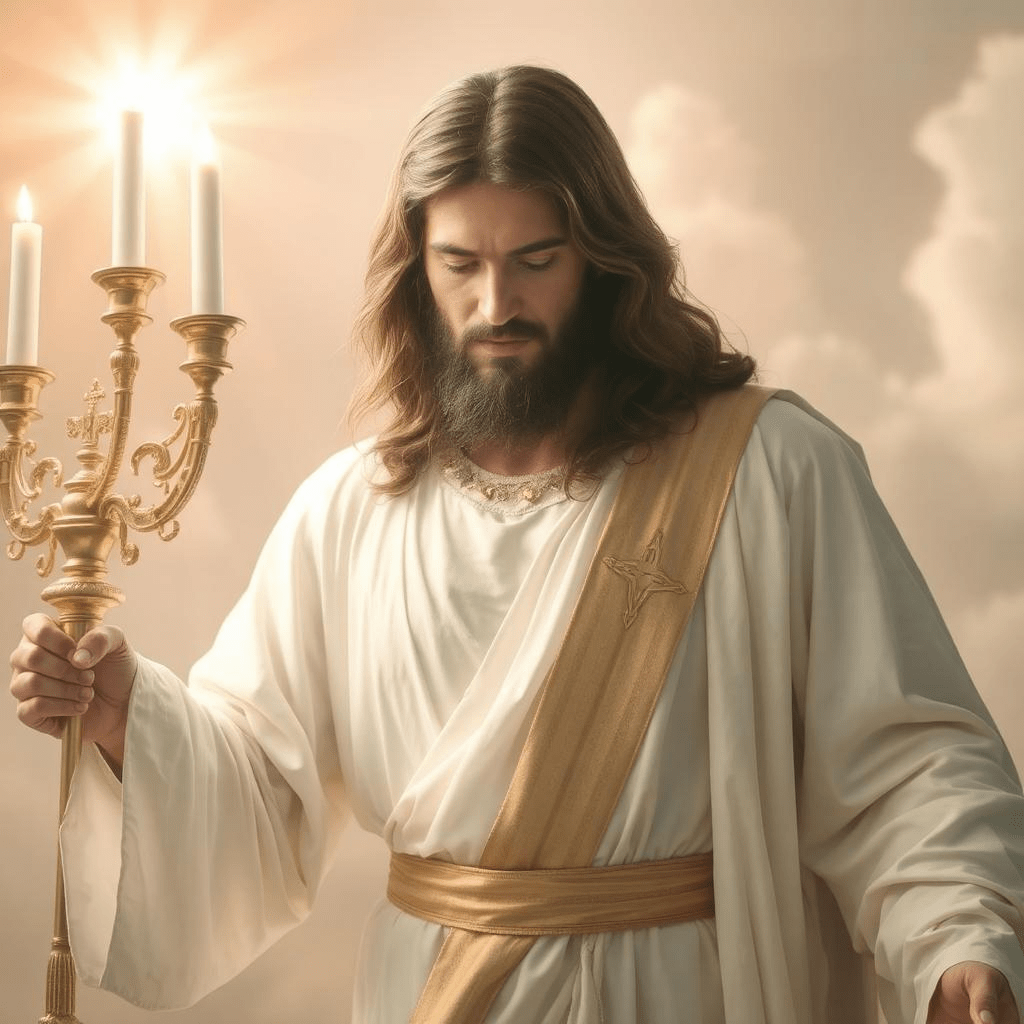
The Christ (Ch. 1)
The Revelation of Jesus Christ’s Person and Authority
Click to Read Lesson 1
Parallel Study of Revelation 1
Revelation 1 serves as the introduction to the book, revealing Jesus Christ as the glorified King and Judge. The chapter emphasizes:
- Jesus as the central figure (1:1-3)
- John’s commission to write the visions he receives (1:4-11)
- The glorious appearance of Christ among the churches (1:12-16)
- Christ’s authority over history, life, and death (1:17-20)
The chapter sets the stage for the entire book by affirming Christ’s sovereignty, majesty, and control over the future.
Now, let’s begin with
The Character of Christ (1:1-8)
| Interpretation | The Character of Christ (1:1-8) – Christ’s Divine Nature, Eternal Existence, and Redemptive Work |
|---|---|
| Preterist | Revelation was written for 1st-century Christians under Roman persecution. Christ’s “coming” (v.7) refers to judgment on Jerusalem (A.D. 70), not the Second Coming. His Alpha & Omega title highlights His control over history. |
| Historicist | Christ is revealed as the eternal ruler over history, guiding the church through various ages. The “coming with clouds” (v.7) is understood as Christ’s continual judgment and intervention throughout history. |
| Futurist | This passage emphasizes Christ’s Second Coming as a future event where He will return to judge the world. The phrase “every eye will see Him” (v.7) is interpreted literally as a global event at the end of time. |
| Idealist | Christ’s eternal nature and redemptive work symbolize His ongoing presence and victory over evil. His “coming” (v.7) represents His continued work in the Church rather than a one-time historical event. |
Great! Let’s continue our parallel study through the rest of Chapter 1.
The Commission by Christ (1:9-11)
(Christ’s instruction to John to write to the churches.)
| Interpretation | The Commission by Christ (1:9-11) – Christ’s Instruction to John |
|---|---|
| Preterist | John’s exile on Patmos represents persecution under Rome. The seven churches were literal first-century congregations facing oppression, and Christ’s message was meant to encourage them amid persecution. |
| Historicist | The seven churches symbolize different eras of church history. John’s role in recording the vision signifies ongoing divine guidance throughout history. |
| Futurist | The command to write is part of the prophetic revelation about the end times, which will be fulfilled in the future tribulation period. The seven churches are also seen as representative of different ages of church history. |
| Idealist | John’s commission represents Christ’s ongoing revelation to the Church across time. The seven churches symbolize different spiritual conditions found in all churches throughout history. |
The Countenance of Christ (1:12-16)
(Christ’s glorious and majestic appearance as Judge and King.)
| Interpretation | The Countenance of Christ (1:12-16) – Christ’s Glorious and Majestic Appearance |
|---|---|
| Preterist | Christ’s majestic appearance represents His authority over the churches in John’s time. The imagery (lampstands, sword, shining face) is symbolic of judgment and guidance to the persecuted early Christians. |
| Historicist | The vision of Christ represents His presence throughout church history, defending the faithful and judging corruption. His sword symbolizes His Word judging false teachings and apostasy. |
| Futurist | Christ is revealed in His glorified, judicial role, preparing for end-times judgment. His fiery eyes and sharp sword depict His coming wrath against the wicked in the Tribulation. |
| Idealist | This vision portrays Christ’s eternal glory and His continual role as the Judge and Shepherd of His people. The symbols (lampstands, sword, face shining) represent His truth, justice, and guidance. |
The Command of Christ (1:17-20)
(Christ’s authority over time, death, and the churches.)
| Interpretation | The Command of Christ (1:17-20) – Christ’s Authority Over Time, Death, and the Churches |
|---|---|
| Preterist | Christ tells John “Do not be afraid” to reassure him that He is in control, despite the coming destruction of Jerusalem. Christ holding the keys of death and Hades symbolizes victory over Roman persecution. |
| Historicist | Christ’s authority over death and the churches shows that He is the ruler throughout all of history, guiding and disciplining the Church in different eras. |
| Futurist | Christ declares His sovereignty over history and the afterlife. His authority over death and Hades is linked to His future judgment at the end of the age. |
| Idealist | Christ’s power over time and death represents His ongoing victory over sin and evil, offering hope to believers of all generations. The lampstands symbolize His presence in the Church forever. |
Discussion Questions for Revelation 1
- Which interpretation do you find most compelling for Revelation 1:7 (“Behold, He is coming with the clouds”)? Do you think it refers to **A.D. 70 (Preterist), ongoing interventions in history (Historicist), the Second Coming (Futurist), or a timeless truth (Idealist)? Why?
- How does Christ’s description in Revelation 1:12-16 (fiery eyes, sword from His mouth, shining face) impact your understanding of His role in the Church today? Which interpretative approach aligns best with your view?
- The seven churches are interpreted differently (literal churches, historical church eras, or spiritual conditions). Which perspective do you find most convincing, and why?
- What does it mean for Christ to “hold the keys of Death and Hades” (1:18)? How do the four interpretations differ on this, and which one do you think best explains this phrase?
- Why do you think Revelation starts with a vision of Christ rather than jumping straight into prophecy? How does this introduction shape the rest of the book across different interpretations?
Multiple-Choice Quiz
1. According to the Preterist view, what does Christ’s “coming with the clouds” (Rev. 1:7) refer to?
A) The Second Coming at the end of time
B) The fall of Jerusalem in A.D. 70
C) The rapture of the Church
D) The final resurrection of all believers
2. In the Historicist view, how is the vision of Christ in Revelation 1:12-16 primarily understood?
A) A symbolic depiction of Christ’s ongoing presence and judgment throughout Church history
B) A literal vision of Christ that will be fulfilled at the Second Coming
C) A one-time revelation meant only for John’s personal encouragement
D) A representation of Israel’s restoration in the end times
3. What does the Futurist view teach about Christ’s command to John to write to the churches (Rev. 1:9-11)?
A) It was only meant for the seven literal churches in Asia Minor
B) It contains prophecies specifically for the Great Tribulation period in the future
C) It represents Christ’s ongoing communication with believers through spiritual experiences
D) It was a secret message that John chose to withhold from the Church
4. The Idealist interpretation of Revelation 1:17-20 sees Christ’s authority over death and Hades as:
A) A future event at the final judgment
B) A reference to Christ’s victory over persecution in the first century
C) A timeless spiritual truth about His sovereignty over sin and salvation
D) A prediction of a specific historical event in church history
- 5. How do Futurists interpret the seven churches in Revelation 1-3?
A) As literal first-century churches only
B) As symbols of spiritual conditions found in churches throughout history
C) As a prophecy outlining different ages of church history leading to the Second Coming
D) As representations of future churches that will exist during the Tribulation
MODULE 2
The Churches (Ch. 2-3)
Christ’s Message to the Seven Churches
Click to Read Lesson 2
II. The Churches (Ch. 2-3) – Christ’s Message to the Seven Churches
(Christ’s evaluation of and instructions to the seven churches of Asia Minor.)
Now, let’s examine how each interpretative approach understands Christ’s messages to the churches.
The Commendation of the Churches (2:1-3:22)
(Christ’s praise for faithfulness and good works.)
| Interpretation | The Commendation of the Churches – Christ’s Praise for Faithfulness and Good Works |
|---|---|
| Preterist | The seven churches were real, historical congregations in Asia Minor that faced persecution and challenges. Christ’s commendations highlight their faithfulness during Roman oppression. |
| Historicist | The seven churches represent different eras of Church history. The commendations reflect the virtues of the Church during different historical periods (e.g., Ephesus representing the Apostolic Church, Smyrna symbolizing the persecuted Church of the first centuries, etc.). |
| Futurist | The seven churches may have had literal historical significance, but they also represent prophetic ages of the Church leading up to the Tribulation. The commendations apply to different time periods of Church history, showing how God has always preserved a faithful remnant. |
| Idealist | The commendations are timeless lessons about faithfulness and perseverance that apply to all churches in every era. They symbolize the various spiritual strengths that churches can exhibit at any time in history. |
The Criticism of the Churches (2:1-3:22)
(Christ’s rebuke of spiritual failures and compromise.)
| Interpretation | The Criticism of the Churches – Christ’s Rebuke of Spiritual Failures and Compromise |
|---|---|
| Preterist | The rebukes were directed at specific first-century churches struggling with compromise, heresy, or spiritual decline in the midst of persecution and Roman oppression. |
| Historicist | Each rebuke corresponds to problems within the Church at different points in history (e.g., Thyatira representing the corrupt medieval Church with false teachings, Laodicea symbolizing the lukewarm state of modern Christianity). |
| Futurist | These warnings apply both to the historical churches and to different church ages. The decline of the churches mirrors the Church’s spiritual deterioration leading up to the end times, culminating in Laodicea as the apostate Church of the last days. |
| Idealist | These criticisms are universal warnings about compromise, false teaching, and spiritual decay that apply to all churches and individual believers in any era. Every Christian should evaluate which church they resemble spiritually. |
The Call to the Churches (2:1-3:22)
(Christ’s invitation to repent and remain faithful.)
| Interpretation | The Call to the Churches – Christ’s Invitation to Repent and Remain Faithful |
|---|---|
| Preterist | Christ’s call to repentance was an urgent plea for first-century churches to stand firm amid persecution, remain faithful, and avoid judgment, especially as the destruction of Jerusalem (A.D. 70) approached. |
| Historicist | This represents God’s repeated call to repentance throughout church history. Different eras of the Church have experienced spiritual decline, but Christ has continually called His people to revival and restoration. |
| Futurist | The call applies to individuals and churches today, but it also foreshadows the need for repentance leading up to the Great Tribulation. Some see the Philadelphia church representing the faithful remnant, while Laodicea represents apostate Christianity in need of repentance. |
| Idealist | Christ’s words reflect the ongoing struggle of believers in every generation. The message is timeless—every Christian must continually repent and remain faithful to avoid spiritual complacency. |
The Conquest for the Churches (2:1-3:22)
(Christ’s promise of rewards to overcomers.)
| Interpretation | The Conquest for the Churches – Christ’s Promise of Rewards to Overcomers |
|---|---|
| Preterist | The promises of rewards (e.g., the tree of life, the crown of life) were encouragements to first-century Christians suffering under Roman persecution. These victories represented their endurance and faithfulness despite suffering. |
| Historicist | The rewards symbolize different blessings given to faithful Christians in various historical periods. The triumph of the Reformation era, missionary expansion, and faithful revival movements all reflect Christ’s rewards to His overcomers. |
| Futurist | These promises ultimately point to the rewards believers will receive in eternity. Some view these as prophecies of heavenly rewards for faithful Christians who endure trials leading up to or during the Tribulation period. |
| Idealist | The promises apply to all Christians who remain faithful to Christ. Every believer who perseveres in faith will receive spiritual rewards, both in this life and in the life to come. |
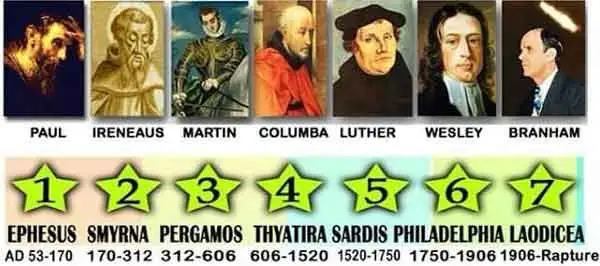
Futurist and Historicist Similarities and Difference in Interpretation of the Seven Churches
Both Futurist and Historicist interpreters agree that the seven churches of Revelation 2–3 were real, literal congregations in Asia Minor (modern Turkey) during John’s time. That is the first level of meaning no matter what view you take.
But when it comes to their prophetic meaning, the two views overlap a lot but are not exactly the same.
Similarities
- Both views see the seven churches as prophetic of successive stages of church history.
- Both end with Laodicea as the lukewarm, end-time church.
- Both see Ephesus as the apostolic era and Smyrna as the persecuted church under Rome.
- Both see Philadelphia as the faithful/missionary revival church.
Differences
📊 Quick Comparison Table
| Church | Historicist | Futurist (Dispensational) |
|---|---|---|
| Ephesus | Apostolic Church (1st c.) | Apostolic Church (30–100 AD) |
| Smyrna | Persecuted Church (2nd–3rd c.) | Persecuted Church (100–313 AD) |
| Pergamum | State Church (Constantine era) | Compromising Church (313–590 AD) |
| Thyatira | Corrupt Church, Papacy (6th–15th c.) | Medieval Church, Roman Catholic dominance (590–1517 AD) |
| Sardis | Pre-Reformation Dead Church | Reformation & Post-Reformation (1517–1700s) |
| Philadelphia | Faithful/Missionary Church (17th–18th c.) | Missionary/Revival Church (1700s–1800s) |
| Laodicea | Lukewarm Church, modern era | Lukewarm End-time Church (1900s–present) |
Discussion Questions for Revelation 2-3
(Exploring the messages to the seven churches through different interpretations.)
- Which interpretation (Preterist, Historicist, Futurist, or Idealist) do you think best explains the significance of the seven churches? Why?
- Do you believe Christ’s praise and criticisms of the seven churches are still relevant to churches today? How does each interpretation influence your view?
- How does the Historicist view of the seven churches as representing different church ages shape our understanding of Christian history? Do you find this convincing? Why or why not?
- The Laodicean church (Rev. 3:14-22) is often seen as symbolic of lukewarm Christianity. Which interpretation (Preterist, Historicist, Futurist, Idealist) best describes your view of this passage?
- What does Christ’s promise of rewards to the overcomers teach us about perseverance in faith? How do the four views apply this concept differently?
Multiple-Choice Quiz
1. According to the Preterist view, what was the primary purpose of Christ’s messages to the seven churches?
A) They were prophetic descriptions of different church ages.
B) They were instructions and warnings for first-century churches facing Roman persecution.
C) They symbolized timeless spiritual conditions that apply to all believers.
D) They describe future churches that will exist during the Great Tribulation.
2. In the Historicist interpretation, the seven churches represent:
A) Different spiritual conditions found in churches throughout all history.
B) Seven literal churches in Asia Minor with no prophetic significance.
C) Seven chronological periods in Church history from the Apostolic Age to the modern era.
D) The final seven years of world history before Christ’s return.
3. How does the Futurist view understand the Laodicean church?
A) As a historical first-century church struggling with lukewarm faith.
B) As a representation of modern apostate Christianity before the end times.
C) As a symbolic warning about complacency in all churches.
D) As a secret group of believers in the Tribulation period.
4. Which interpretation sees the messages to the churches as spiritual lessons applicable to all believers at all times?
A) Preterist
B) Historicist
C) Futurist
D) Idealist
5. What is one key difference between the Preterist and Futurist views regarding the seven churches?
A) Preterists believe the churches were real first-century congregations, while Futurists see them as representing different church ages.
B) Preterists see the churches as symbolic of the Tribulation period, while Futurists see them as historical accounts.
C) Preterists believe the churches were only meant for future generations, while Futurists see them as historical lessons.
D) Preterists think the churches never actually existed, while Futurists believe they were only spiritual metaphors.
MODULE 3
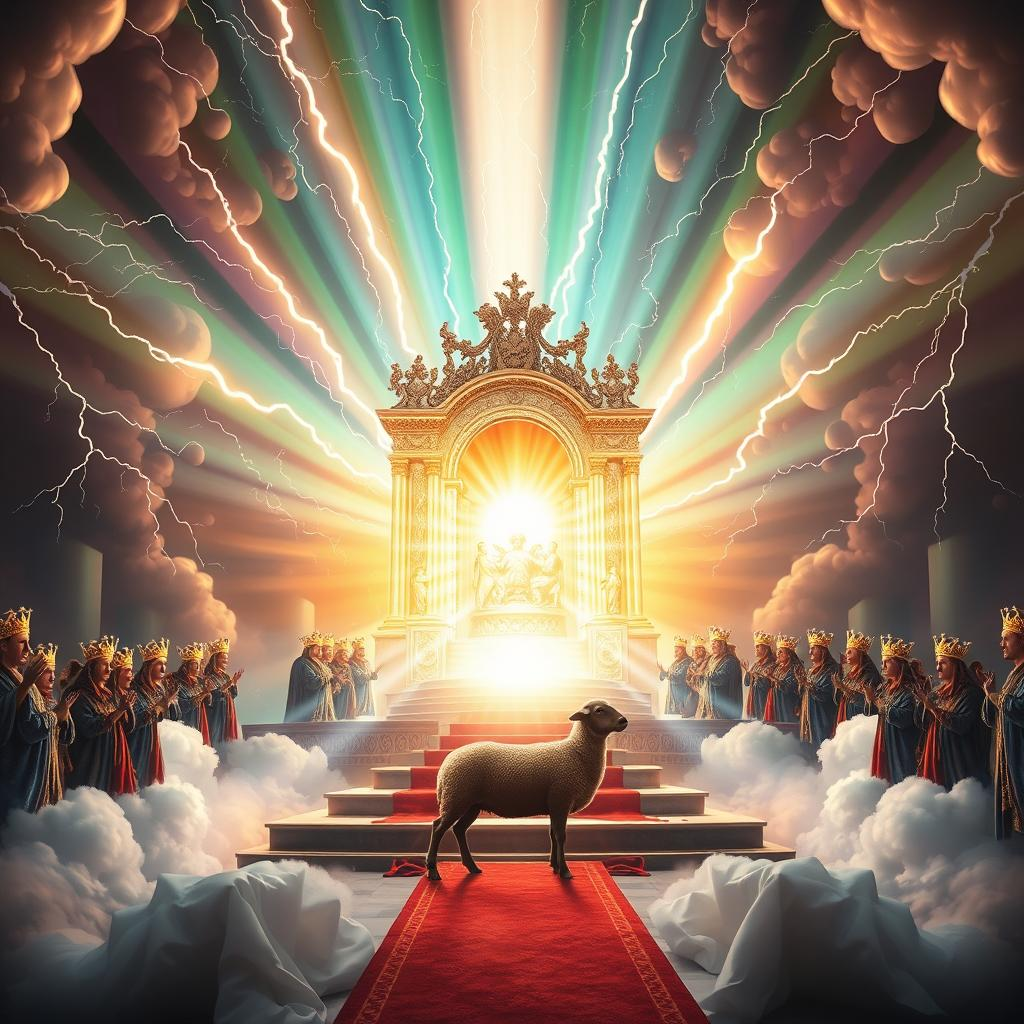
The Court of Heaven (Ch. 4-5)
The Throne Room of God and the Worthiness of Christ
Click to Read Details
III. The Court of Heaven (Ch. 4-5) – The Throne Room of God and the Worthiness of Christ
(A vision of God’s sovereign rule, heavenly worship, and Christ’s authority to execute judgment.)
Now, let’s explore how the four interpretative approaches understand this heavenly vision in Revelation 4-5.
The Celestial Throne (4:1-6)
(The majesty and sovereignty of God in heaven.)
| Interpretation | The Celestial Throne – The Majesty and Sovereignty of God in Heaven |
|---|---|
| Preterist | John’s vision represents God’s rule over history, particularly His judgment on Jerusalem (A.D. 70). The throne signifies God’s authority over earthly rulers, reminding persecuted believers that Rome will not prevail forever. |
| Historicist | The vision depicts God’s sovereignty over Church history. It reflects a period when the Church transitioned from earthly struggle to recognizing God’s ultimate control. Some see this as the elevation of Christianity after Constantine’s rise. |
| Futurist | The scene symbolizes the rapture of the Church, with John being caught up into heaven (Rev. 4:1). It portrays God preparing to unleash end-times judgments on the world. The heavenly throne represents God’s authority over the coming Tribulation. |
| Idealist | The throne is a timeless vision of God’s majesty and divine sovereignty. It teaches that God reigns over all creation and calls believers to worship Him with awe and reverence. |
The Cherubim’s Worship (4:7-11)
(The unceasing worship of God by angelic beings.)
| Interpretation | The Cherubim’s Worship – The Unceasing Worship of God by Angelic Beings |
|---|---|
| Preterist | The worship signifies God’s eternal rule over all nations and events. It reassures early Christians that God, not Caesar, is the true King. |
| Historicist | This represents different periods of Church history exalting God’s sovereignty. Some see it as the Church’s worship during the medieval period, elevating God in times of hardship. |
| Futurist | The four living creatures and the elders represent redeemed believers and angelic hosts glorifying God in heaven. This scene precedes the judgments of the Tribulation and shows that God is worthy to judge the earth. |
| Idealist | This vision is a symbol of continuous divine worship, illustrating how all creation exists to glorify God. It calls believers to join in unceasing praise and submission to God’s rule. |
The Covenant Scroll (5:1-4)
(The sealed book containing God’s redemptive plan.)
| Interpretation | The Covenant Scroll – The Sealed Book Containing God’s Redemptive Plan |
|---|---|
| Preterist | The scroll represents God’s decrees of judgment against Jerusalem, leading to the destruction of the temple in A.D. 70. The sealed judgments signify the impending downfall of apostate Israel. |
| Historicist | The scroll symbolizes God’s unfolding plan for Church history. Some view it as the Bible, which was opened during the Reformation. Others see it as the progressive revelation of God’s will throughout history. |
| Futurist | The scroll represents God’s title deed to the earth and His judgment on the world. The seals will be opened in Revelation 6, unleashing the Tribulation judgments. |
| Idealist | The scroll symbolizes God’s sovereign will and His hidden purposes, which only Christ can reveal. It teaches that history unfolds according to God’s divine plan, and believers must trust in His timing. |
The Conquering Lamb (5:5-14)
(Christ as the worthy Redeemer and rightful ruler.)
| Interpretation | The Conquering Lamb – Christ as the Worthy Redeemer and Rightful Ruler |
|---|---|
| Preterist | Christ, the Lamb, is the victorious Messiah, executing judgment on Israel’s unfaithfulness and bringing salvation to His faithful followers. |
| Historicist | The Lamb’s victory represents key moments in Church history where Christ triumphed (e.g., the spread of Christianity, the Reformation, or the fall of oppressive regimes). |
| Futurist | The Lamb takes the scroll. He is the rightful ruler of the earth. He prepares to open the seals and begin the Tribulation judgments. This is a pivotal moment leading to end-times events. |
| Idealist | The Lamb represents Christ’s ongoing victory over sin and death. This vision reminds believers of Christ’s ultimate triumph and calls them to worship and trust in His power. |
Discussion Questions for Revelation 4-5
(Exploring the Throne Room of God and the Worthiness of Christ through different interpretations.)
- How does each interpretative view (Preterist, Historicist, Futurist, Idealist) shape our understanding of God’s sovereignty as seen in Revelation 4?
- The scroll in Revelation 5 is a key symbol. Which interpretation do you find most convincing regarding its meaning (God’s judgment on Jerusalem, the unfolding of Church history, the Tribulation judgments, or God’s eternal plan)? Why?
- The worship of the Lamb is central in Revelation 5:5-14. How do the four views understand Christ’s victory differently? Which perspective aligns most with your understanding of His role?
- In the Futurist view, Revelation 4:1 is often linked to the rapture of the Church. Do you find this interpretation compelling? Why or why not?
- How does the scene of worship in heaven (Rev. 4-5) influence how we worship God today? Do you think this passage provides insights that transcend all interpretations?
Multiple-Choice Quiz
1. According to the Preterist view, what does the throne in Revelation 4 symbolize?
A) The final judgment of the world at the end of time.
B) God’s rule over history, particularly His judgment on Jerusalem in A.D. 70.
C) The beginning of the Church Age and Christ’s spiritual reign on earth.
D) The earthly throne of the Antichrist before Christ’s return.
2. In the Historicist view, what does the scroll in Revelation 5 represent?
A) The book of life, containing the names of the redeemed.
B) The opening of Church history, with key moments unfolding through the centuries.
C) A prophecy about Israel’s restoration in the last days.
D) A metaphor for personal spiritual growth and sanctification.
3. How does the Futurist view understand the scene of worship in Revelation 4?
A) A vision of first-century believers praising God before Jerusalem’s fall.
B) A celebration of the Church’s faithfulness throughout history.
C) A future scene where the raptured Church worships God before the Tribulation begins.
D) A timeless vision representing the eternal praise of God by all of creation.
4. What is the main theme of the Idealist interpretation of Revelation 4-5?
A) The specific historical fall of Jerusalem in A.D. 70.
B) The rise and fall of different Church ages.
C) The timeless truth of God’s sovereignty and Christ’s victory, applicable to all believers.
D) A detailed roadmap of future events leading to Christ’s second coming.
5. In Revelation 5, why is Christ portrayed as both a Lion and a Lamb?
A) To show that He is both the conquering King and the sacrificial Savior.
B) To demonstrate that He ruled Jerusalem but also suffered under Roman persecution.
C) To symbolize the conflict between good and evil in Church history.
D) To hint at the dual nature of Christ as both angelic and human.
MODULE 4
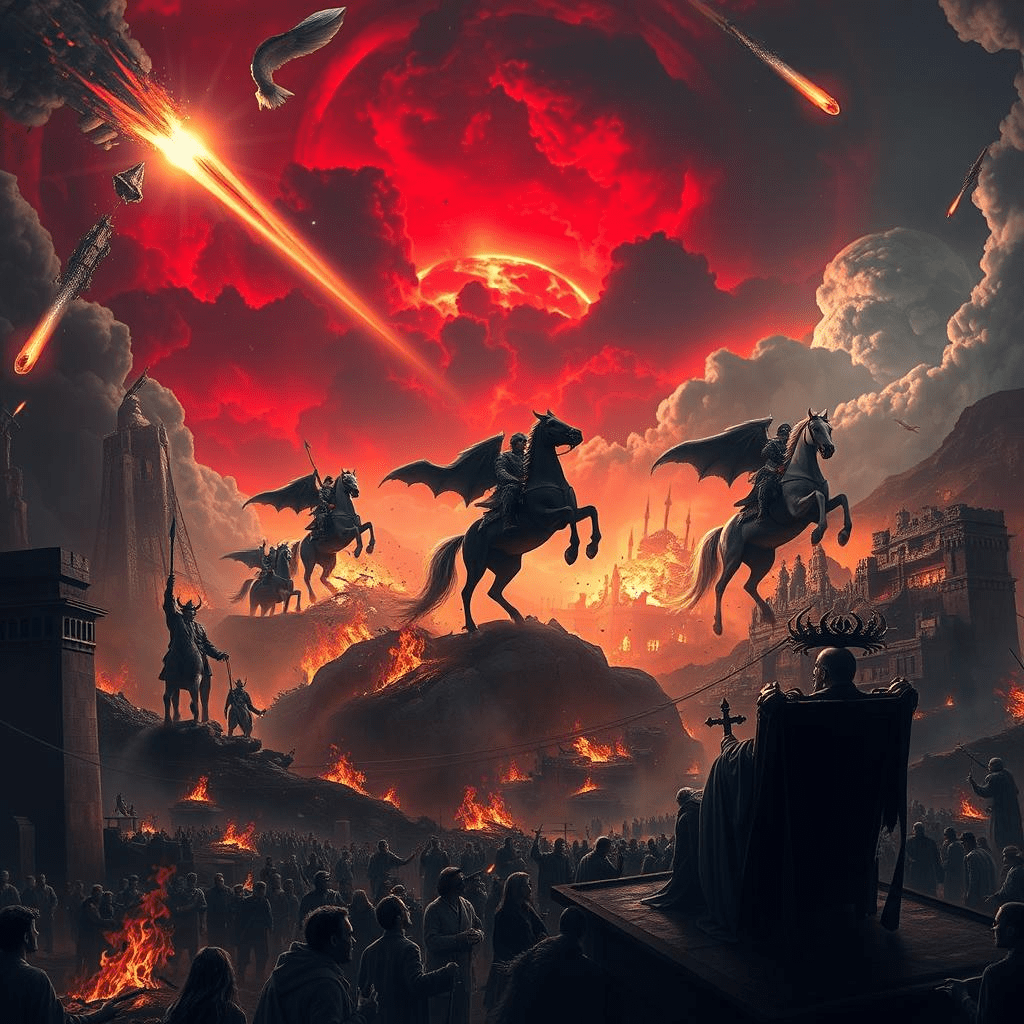
The Catastrophe (Ch. 6-18)
The Judgments of God During the Tribulation
Click to Read Details
IV. The Catastrophe (Ch. 6-18) – The Judgments of God During the Tribulation
(A detailed portrayal of divine judgments upon the earth, spiritual conflict, and the fall of the world’s corrupt system.)
This section covers the major judgment sequences (Seals, Trumpets, and Bowls) and key figures like the Dragon (Satan), the Beast (Antichrist), and Babylon (the corrupt world system).
Now, let’s examine each event through the four interpretative approaches.
The Conquest of the Rider (Seal Judgments) (6:1-17)
(The release of the four horsemen and early judgments.)
| Interpretation | The Conquest of the Rider – The Release of the Four Horsemen and Early Judgments |
|---|---|
| Preterist | The seals symbolize the events leading to Jerusalem’s destruction (A.D. 66-70): war, famine, disease, and death affecting the Jewish people and Roman world. |
| Historicist | The seals represent stages of Church history (e.g., conquest = Roman military expansion, famine = economic struggles, death = widespread plagues). |
| Futurist | The seals begin the seven-year Tribulation, with the Antichrist (rider on the white horse) deceiving the world, followed by war, famine, and death. |
| Idealist | The four horsemen represent ongoing realities throughout history—deception, war, suffering, and judgment—that occur repeatedly in human civilization. |
The Cry of the Martyrs (7:1-17)
(The suffering of believers and their vindication.)
| Interpretation | The Cry of the Martyrs – The Suffering of Believers and Their Vindication |
|---|---|
| Preterist | The martyrs are first-century Christians persecuted by Rome or Jewish leaders before Jerusalem’s fall. |
| Historicist | The martyrs represent believers who suffered under oppressive regimes throughout Church history (e.g., Roman persecution, Inquisition, etc.). |
| Futurist | These are believers who come to faith during the Tribulation and are martyred by the Antichrist’s regime. |
| Idealist | The martyrs symbolize all Christians who have suffered for their faith throughout history, showing that God sees and will vindicate His people. |
The Cataclysms of the Trumpets (8:1-11:19)
(Intensified divine judgments on the earth.)
| Interpretation | The Cataclysms of the Trumpets – Intensified Divine Judgments on Earth |
|---|---|
| Preterist | The trumpets describe worsening disasters in the Roman Empire leading to Jerusalem’s destruction. |
| Historicist | The trumpets represent invasions (e.g., fall of Rome, Islamic conquests, plagues) affecting Christendom over time. |
| Futurist | The trumpets bring escalating supernatural judgments during the Tribulation, affecting land, sea, rivers, and the heavens. |
| Idealist | The trumpets symbolize spiritual warnings and divine consequences that have recurred throughout history. |
The Conflict with the Dragon (12:1-17)
(Satan’s war against God’s people.)
| Interpretation | The Conflict with the Dragon – Satan’s War Against God’s People |
|---|---|
| Preterist | The woman represents faithful Israel or the early Church, and the dragon’s persecution refers to Jewish and Roman opposition. |
| Historicist | This chapter describes the struggle between the true Church and corrupt religious-political powers throughout history. |
| Futurist | The woman is Israel, and the dragon is Satan attempting to destroy the Jewish people and the Messiah. This chapter foreshadows intense persecution during the Tribulation. |
| Idealist | The passage illustrates the cosmic battle between good and evil, with the Church constantly engaged in spiritual warfare. |
The Corruption of the Beast (13:1-18)
(The rise of the Antichrist and false prophet.)
| Interpretation | The Corruption of the Beast – The Rise of the Antichrist and False Prophet |
|---|---|
| Preterist | The Beast represents Rome’s oppressive emperors, especially Nero, who persecuted Christians. |
| Historicist | The Beast symbolizes various corrupt world leaders and oppressive religious systems, often linked to the papacy or political tyranny. |
| Futurist | The Beast is the Antichrist, a future world dictator who will demand worship and rule over a one-world government. |
| Idealist | The Beast represents all oppressive powers that oppose God, reminding Christians to resist worldly corruption. |
The Call of the Angels (14:1-20)
(Angelic warnings and proclamations of judgment.)
| Interpretation | The Call of the Angels – Angelic Warnings and Proclamations of Judgment |
|---|---|
| Preterist | The angelic messages warn of impending judgment on Jerusalem and Rome. |
| Historicist | The angels represent Reformation-era warnings against corrupt religious and political systems. |
| Futurist | These angels announce final warnings before God’s wrath is fully poured out during the Tribulation. |
| Idealist | Angelic messages symbolize God’s ongoing call to repentance before divine judgment falls on wickedness. |
The Cups of Wrath (Bowl Judgments) (15:1-16:21)
(The final outpouring of God’s wrath.)
| Interpretation | The Cups of Wrath – The Final Outpouring of God’s Wrath |
|---|---|
| Preterist | The bowls symbolize the complete devastation of Jerusalem and Rome’s downfall. |
| Historicist | The bowls represent divine judgment on historical nations or corrupt Church powers (e.g., French Revolution, plagues, World Wars). |
| Futurist | These judgments occur in the latter half of the Tribulation, bringing God’s final and most severe plagues upon the earth. |
| Idealist | The bowls illustrate God’s righteous judgment upon persistent evil throughout history. |
The Collapse of Babylon (17:1-18:24)
(The destruction of the world’s corrupt system.)
| Interpretation | The Collapse of Babylon – The Destruction of the World’s Corrupt System |
|---|---|
| Preterist | Babylon refers to Jerusalem or Rome, both of which were judged for their sins. |
| Historicist | Babylon is the corrupt political and religious systems that opposed true Christianity throughout history. |
| Futurist | Babylon is a future global economic-religious system controlled by the Antichrist, which God will destroy before Christ’s return. |
| Idealist | Babylon represents humanity’s rebellion against God in every age, from ancient empires to modern secularism. |
Discussion Questions for Revelation 6-18
- How do the four interpretative approaches differ in their understanding of the Four Horsemen of the Apocalypse?
- In what ways do the Trumpet and Bowl judgments reflect past, present, or future divine justice, depending on the interpretative view?
- How does the identity of the Beast (Revelation 13) change based on the Preterist, Historicist, Futurist, and Idealist perspectives?
- What significance does Babylon hold in each interpretative approach? How does this influence how we view corruption in the world today?
- What are the theological and practical implications of the Cry of the Martyrs in different interpretative views? How does this shape our understanding of Christian suffering and persecution?
Multiple Choice Quiz
1. According to the Futurist view, who is the rider on the white horse in the Seal Judgments?
a) Jesus Christ
b) The Antichrist
c) The Apostle John
d) The Archangel Michael
2. In the Historicist interpretation, the Trumpet Judgments are often associated with:
a) The fall of Jerusalem
b) The Reformation and the fall of the Papacy
c) The future Great Tribulation
d) The early spread of Christianity
3. In the Idealist view, the conflict with the Dragon (Revelation 12) represents:
a) Satan’s opposition to the Church throughout all of history
b) A literal war between Israel and the Antichrist
c) The destruction of Rome in A.D. 70
d) A temporary conflict that has already been resolved
4. Which interpretative approach sees the Bowl Judgments as describing God’s final and severe punishments just before Christ’s return?
a) Preterist
b) Historicist
c) Futurist
d) Idealist
5. According to the Preterist view, what does “Babylon” most likely represent in Revelation 17-18?
a) A future one-world government
b) The Roman Empire or Jerusalem before its destruction
c) The final stronghold of the Antichrist
d) A purely symbolic depiction of evil
MODULE 5
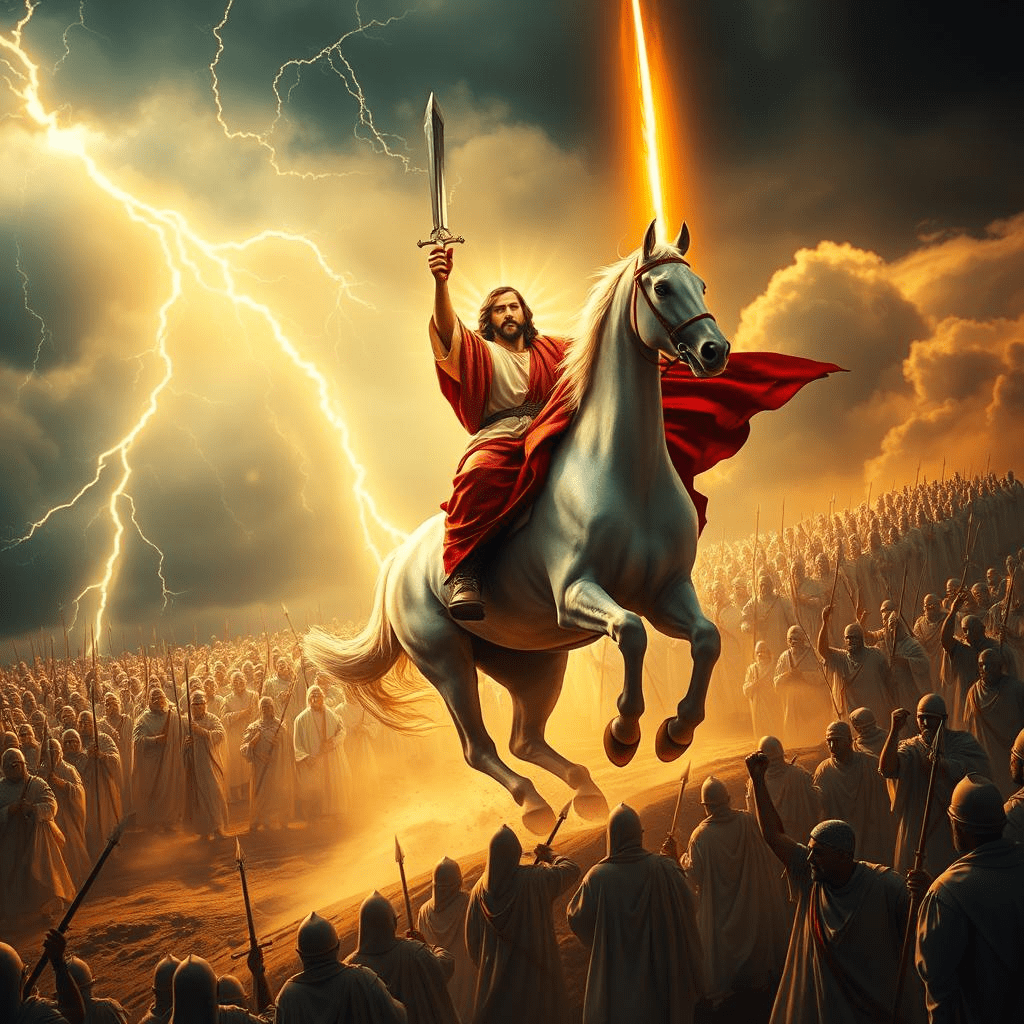
The Coming of Christ (Ch. 19)
The Grand Wedding and Triumphant Return of Jesus Christ
Click to Read Details
The Coming of Christ – The Triumphant Return of Jesus Christ
(A depiction of the glorious return of Jesus Christ, the victory over evil, and the establishment of His rule.)
Now, let’s examine each event through the four interpretative approaches.
The Celebration in Heaven (19:1-10)
(The Marriage Supper of the Lamb and rejoicing in heaven.)
| Interpretation | The Celebration in Heaven – The Marriage Supper of the Lamb and Rejoicing in Heaven |
|---|---|
| Preterist | The celebration follows the destruction of Jerusalem (A.D. 70) or Rome, symbolizing God’s vindication of the faithful. The Marriage Supper represents the Church’s spiritual union with Christ after judgment. |
| Historicist | The Marriage Supper represents the triumph of the true Church over oppressive religious-political powers. This is often linked to the downfall of the Papacy or corrupt religious institutions. |
| Futurist | This is a literal event in heaven. The redeemed Church celebrates its union with Christ there. This celebration occurs before His return to earth at the end of the Tribulation. |
| Idealist | The Marriage Supper is a symbolic picture of the eternal joy and union between Christ and His people. It represents the ultimate fulfillment of God’s promise to His Church. |
The Conquering King Returns (19:11-16)
(Christ’s Second Coming in power and glory.)
| Interpretation | The Conquering King Returns – Christ’s Second Coming in Power and Glory |
|---|---|
| Preterist | Christ’s “coming” here is symbolic of divine judgment upon Jerusalem or Rome, not a literal Second Coming. |
| Historicist | This represents the progressive triumph of Christ over oppressive forces in history, such as the Reformation’s victory over corrupt institutions. |
| Futurist | Christ will literally and visibly return to earth at the end of the Tribulation, defeating the Antichrist and establishing His millennial kingdom. |
| Idealist | Christ’s coming represents the ongoing victory of Christ over evil throughout history, culminating in His final triumph over all wickedness. |
The Crushing of the Armies (19:17-21)
(Christ’s victory over the forces of evil at Armageddon.)
| Interpretation | The Crushing of the Armies – Christ’s Victory Over the Forces of Evil at Armageddon |
|---|---|
| Preterist | The destruction of the armies symbolizes the defeat of Israel’s rebellious factions or Rome’s downfall under divine judgment. |
| Historicist | This represents God’s continuous judgment against oppressive nations and religious-political institutions opposing true Christianity. |
| Futurist | This describes the literal Battle of Armageddon, where Christ will destroy the Antichrist’s armies and establish His rule. |
| Idealist | The battle symbolizes the final overthrow of all forces of evil. It represents the spiritual struggle between Christ and all ungodly powers throughout history. |
Discussion Questions for Revelation 19
- How does the Marriage Supper of the Lamb relate to the theme of Christ’s ultimate union with His people? How is this union seen across the four interpretative views?
- What are the key differences between the Preterist and Futurist views of Christ’s Second Coming in Revelation 19:11-16?
- How does the Battle of Armageddon in Revelation 19:17-21 symbolize divine judgment in each interpretative approach?
- Why is the imagery of Christ as a conquering warrior significant? How does each interpretative view apply this image to history, theology, or eschatology?
- How do these passages in Revelation 19 encourage believers, regardless of their interpretative stance?
Multiple Choice Quiz (with Answers)
1. According to the Preterist view, what does the Marriage Supper of the Lamb in Revelation 19:1-10 represent?
A) A literal banquet in heaven
B) The Church’s union with Christ after the destruction of Jerusalem
C) The celebration of Christ’s return at the end of the world
D) The judgment of the Antichrist
2. How does the Historicist interpretation understand Christ’s Second Coming in Revelation 19:11-16?
A) A progressive triumph of Christ over corrupt institutions
B) A symbolic picture of spiritual warfare
C) A future event that will take place after the Tribulation
D) The fall of Babylon in ancient times
3. In the Futurist view, what is the significance of Christ’s return in Revelation 19?
A) It symbolizes the fall of the Roman Empire
B) It marks the literal Second Coming of Christ to defeat the Antichrist and establish His millennial reign
C) It represents the Church’s struggle against sin
D) It is a metaphor for spiritual renewal
4. How does the Idealist interpretation view the Battle of Armageddon in Revelation 19:17-21?
A) A spiritual and ongoing struggle between good and evil
B) A literal war fought in the Middle East
C) A historical event that occurred in the first century
D) A reference to the Black Plague
5. According to the Futurist perspective, who are the armies that Christ defeats in Revelation 19:17-21?
A) The Jewish people who rejected Christ
B) The armies of the Antichrist at the Battle of Armageddon
C) The Roman legions that destroyed Jerusalem
D) The forces of the Reformation
MODULE 6
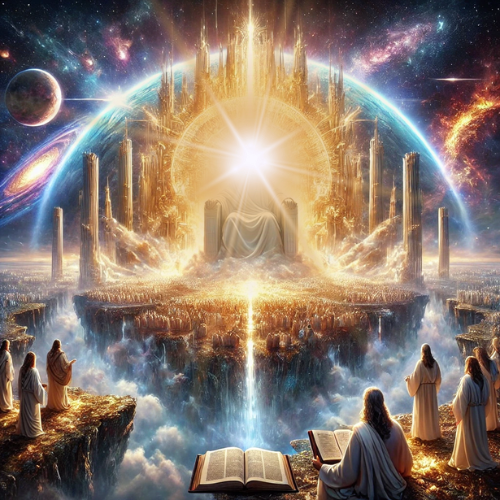
The Consummation by Christ (Ch. 20)
The Final Victory and Eternal Judgment
Click to Read Details
VI. The Consummation by Christ (Ch. 20) – The Final Victory and Eternal Judgment
(A depiction of the binding of Satan, the millennial reign, the final rebellion, and the last judgment.)
| Interpretation | The Capturing of Satan (20:1-3) – Satan’s Binding During the Millennial Reign of Christ |
|---|---|
| Preterist | Satan’s binding symbolizes the restriction of demonic influence over the Church following Christ’s victory through His death and resurrection. Some Preterists believe this was fulfilled in the early Church era. |
| Historicist | The binding of Satan represents an extended period of diminished satanic influence in history, often associated with the spread of Christianity after the fall of Rome. |
| Futurist | Satan will be literally bound for a thousand years after Christ’s return, marking the beginning of the Millennium. This period will be a literal reign of Christ on earth. |
| Idealist | The binding of Satan is symbolic of Christ’s power over evil. It represents the ongoing spiritual victory of Christ’s kingdom in the hearts of believers. |
| Interpretation | The Coronation of the Saints (20:4-6) – The Reign of Believers with Christ for a Thousand Years |
|---|---|
| Preterist | The reign of the saints refers to the vindication of persecuted Christians who are spiritually ruling with Christ in the present age. |
| Historicist | The thousand-year reign symbolizes a golden age of Christianity when the Gospel flourished, often associated with the Reformation period. |
| Futurist | Believers will physically reign with Christ in a literal thousand-year kingdom on earth, after His Second Coming. |
| Idealist | The reign of the saints represents the spiritual authority of believers throughout history, emphasizing Christ’s rule through His Church. |
| Interpretation | The Conspiracy of the Rebels (20:7-10) – The Final Rebellion and Ultimate Defeat of Satan |
|---|---|
| Preterist | This event represents a symbolic depiction of spiritual conflicts after Christ’s resurrection, with judgment on rebellious nations. |
| Historicist | The final rebellion refers to a great apostasy that happens toward the end of Church history before the final judgment. |
| Futurist | After the Millennium, Satan will be released for one final rebellion, gathering nations against Christ before his ultimate defeat. |
| Idealist | The final rebellion symbolizes the recurring nature of evil’s resistance to God’s rule and its ultimate destruction by divine judgment. |
| Interpretation | The Condemnation at the Great White Throne (20:11-15) – The Final Judgment of Unbelievers |
|---|---|
| Preterist | The Great White Throne Judgment symbolizes God’s judgment against Jerusalem or Rome. It marks a historical end for those who rejected Christ. |
| Historicist | This event represents the final judgment of humanity at the end of the Church Age. At this time, all are judged according to their deeds. |
| Futurist | There will be a literal final judgment. All the unsaved will be resurrected and cast into the lake of fire. This will mark the end of sin and evil. |
| Idealist | A symbolic portrayal of divine justice, showing that God will ultimately judge all evil and vindicate the righteous. |
Discussion Questions for Revelation 20
- How do the different views interpret the concept of the Millennium? Which interpretation do you find most compelling, and why?
- What does the binding of Satan mean in each interpretative approach? How does this affect our understanding of spiritual warfare today?
- How does the final rebellion in Revelation 20:7-10 challenge the idea that a perfect environment guarantees righteousness?
- In what ways does the Great White Throne Judgment emphasize God’s justice and mercy across the different interpretations?
- What practical lessons can believers draw from the idea that Christ and His saints will reign, whether spiritually or literally?
Multiple Choice Quiz
- According to the Futurist view, how long will Christ reign on earth after His Second Coming?
a) 100 years
b) 500 years
c) 1,000 years
d) Eternally - In the Idealist perspective, what does the binding of Satan primarily represent?
a) The restriction of evil forces throughout all of history
b) The physical imprisonment of Satan in the underworld
c) The destruction of Rome in the first century
d) The rise of the Antichrist - Which interpretative approach views the Millennium as a symbolic period rather than a literal 1,000 years?
a) Preterist
b) Historicist
c) Idealist
d) All of the above - In the Preterist interpretation, who or what does the Great White Throne Judgment primarily address?
a) The final judgment of all humanity
b) The destruction of Jerusalem or Rome
c) The judgment of Satan alone
d) The victory of the Antichrist - What happens to Satan at the end of the events in Revelation 20, according to the Futurist view?
a) He is allowed to rule over a rebellious world
b) He is permanently cast into the lake of fire
c) He repents and is forgiven
d) He conquers the nations and defeats Christ.
MODULE 7

The Celestial City (Ch. 21-22)
The New Heaven, New Earth, and Eternal Glory
Click to Read Details
VII. The Celestial City (Ch. 21-22) – The New Heaven, New Earth, and Eternal Glory
(A vision of the ultimate renewal of all things, where God dwells with His people in perfect harmony.)
This section presents the final fulfillment of God’s redemptive plan, describing the new creation, the Holy City, and eternal communion with God. The four interpretative approaches provide distinct perspectives on the nature and timing of these events.
The Creation of the New Heaven and Earth (21:1-8)
(The renewal of all things by God.)
| Interpretation | The Creation of the New Heaven and Earth – The Renewal of All Things |
|---|---|
| Preterist | The destruction of Jerusalem ushered in a new covenant era, symbolizing the renewal of God’s people rather than a literal new heaven and earth. |
| Historicist | The passing of the old heaven and earth represents the transformation of the Church through history, with the final renewal occurring at the end of the age. |
| Futurist | A literal new heaven and earth will be created after the Millennium, following the final judgment, where believers will dwell with God eternally. |
| Idealist | The new heaven and earth represent the complete restoration of God’s order, symbolizing the victory of righteousness over evil throughout history. |
The Construction of the Holy City (21:9-21)
(The beauty and perfection of the New Jerusalem.)
| Interpretation | The Construction of the Holy City – The Beauty and Perfection of the New Jerusalem |
|---|---|
| Preterist | The New Jerusalem symbolizes the Church in its restored state after God’s judgment on Israel, representing the new covenant community. |
| Historicist | The Holy City is the purified Church, built up through history and reaching its full splendor at the end of the age. |
| Futurist | A literal city, New Jerusalem, will descend from heaven and serve as the eternal dwelling place of God’s redeemed people. |
| Idealist | The New Jerusalem represents the perfected kingdom of God, where righteousness dwells and believers experience eternal communion with Him. |
The Communion with God (21:22-27)
(The eternal dwelling of God with His people.)
| Interpretation | The Communion with God – The Eternal Dwelling of God with His People |
|---|---|
| Preterist | The presence of God with His people was fulfilled in the Church after the destruction of the old temple system. |
| Historicist | The Church experiences increasing communion with God throughout history, culminating in the full realization of His presence. |
| Futurist | God’s presence will dwell with His people in the eternal state, where there will be no temple, as God Himself will be the source of light and life. |
| Idealist | This symbolizes the ultimate fulfillment of God’s promise to be with His people, realized spiritually throughout time and eternally in the afterlife. |
The Coming of the Lord (22:1-21)
(The final promise of Christ’s return and invitation to all.)
| Interpretation | The Coming of the Lord – The Final Promise of Christ’s Return and Invitation to All |
|---|---|
| Preterist | Christ’s coming refers to His judgment on Jerusalem in A.D. 70, establishing the new covenant age. |
| Historicist | The passage speaks of Christ’s ongoing presence with His Church throughout history and His final return at the end of time. |
| Futurist | This is a literal prophecy of Christ’s Second Coming, bringing eternal reward for the faithful and judgment for the wicked. |
| Idealist | Christ’s coming is an ongoing reality, as He continually comes to His people in times of spiritual renewal and ultimately at the final consummation. |
Discussion Questions for Revelation 21-22
- How do the different views interpret the concept of a “New Heaven and New Earth,” and what implications does this have for how we live today?
- Why is the New Jerusalem described with such detailed imagery? How do the four interpretative approaches handle the city’s symbolism?
- What does it mean for God to dwell with His people (21:3)? How is this idea fulfilled differently in each interpretation?
- The book of Revelation ends with a call to be ready for Christ’s coming. How does this challenge believers in each interpretative framework?
- In what ways does the final vision of Revelation encourage hope and perseverance for Christians today?
Multiple Choice Quiz
- In the Preterist interpretation, what does the “New Heaven and New Earth” primarily symbolize?
a) A literal, physical recreation of the universe
b) The establishment of the Church after Jerusalem’s destruction
c) The transformation of the Roman Empire
d) The arrival of extraterrestrial beings - According to the Futurist perspective, where will the redeemed live for eternity?
a) On a restored version of the current earth
b) In the old Jerusalem, rebuilt by human efforts
c) In the New Jerusalem, a literal city descending from heaven
d) In a spiritual, non-physical state with no defined location - The Idealist view interprets the Holy City as:
a) A literal golden city with 12 gates and foundations
b) The perfected kingdom of God and His presence among His people
c) The Vatican at the height of its influence
d) A temporary refuge before the final judgment - What is missing from the New Jerusalem, according to Revelation 21:22, and why?
a) The temple, because God and the Lamb are its temple
b) The sun, because it was consumed by fire
c) The sea, because it represents evil and chaos
d) The mountains, because they were cast into the abyss - What is the final promise given in Revelation 22?
a) “You will reign with Christ for a thousand years.”
b) “Behold, I am coming quickly.”
c) “The Antichrist will be overthrown.”
d) “The four horsemen will ride again.”
Conclusion
This final section of Revelation presents the ultimate fulfillment of God’s redemptive plan. While each interpretative approach offers a unique perspective, they all emphasize God’s presence with His people, the triumph of righteousness, and the promise of Christ’s return. Up next: Let’s have a parallel criticism of each views!
WHAT IS ESCHATOLOGY?
Dr. Rhoderick de Vera explored the concept of Eschatology through 14 distinct perspectives. Watch “Mastering Eschatology Course” video series to gain a deeper understanding!
GRAND OUTLINE OF THE PARALLEL STUDY OF REVELATION IN FOUR DIFFERENT PERSPECTIVES
(Preterist, Historicist, Futurist, and Idealist)
The Book of Revelation: A Grand Outline (Chapters 1-22)
I. The Christ (Ch. 1)
The Revelation of Jesus Christ’s Person and Authority
- The Character of Christ (1:1-8) – Christ’s divine nature, eternal existence, and redemptive work.
- The Commission by Christ (1:9-11) – Christ’s instruction to John to write to the churches.
- The Countenance of Christ (1:12-16) – Christ’s glorious and majestic appearance as Judge and King.
- The Command of Christ (1:17-20) – Christ’s authority over time, death, and the churches.
II. The Churches (Ch. 2-3)
Christ’s Message to the Seven Churches
- The Commendation of the Churches (2:1-3:22) – Christ’s praise for faithfulness and good works.
- The Criticism of the Churches (2:1-3:22) – Christ’s rebuke of spiritual failures and compromise.
- The Call to the Churches (2:1-3:22) – Christ’s invitation to repent and remain faithful.
- The Conquest for the Churches (2:1-3:22) – Christ’s promise of rewards to overcomers.
III. The Court of Heaven (Ch. 4-5)
The Throne Room of God and the Worthiness of Christ
- The Celestial Throne (4:1-6) – The majesty and sovereignty of God in heaven.
- The Cherubim’s Worship (4:7-11) – The unceasing worship of God by angelic beings.
- The Covenant Scroll (5:1-4) – The sealed book containing God’s redemptive plan.
- The Conquering Lamb (5:5-14) – Christ as the worthy Redeemer and rightful ruler.
IV. The Catastrophe (Ch. 6-18)
The Judgments of God During the Tribulation
- The Conquest of the Rider (Seal Judgments) (6:1-17) – The release of the four horsemen and early judgments.
- The Cry of the Martyrs (7:1-17) – The suffering of believers and their vindication.
- The Cataclysms of the Trumpets (8:1-11:19) – Intensified divine judgments on the earth.
- The Conflict with the Dragon (12:1-17) – Satan’s war against God’s people.
- The Corruption of the Beast (13:1-18) – The rise of the Antichrist and false prophet.
- The Call of the Angels (14:1-20) – Angelic warnings and proclamations of judgment.
- The Cups of Wrath (Bowl Judgments) (15:1-16:21) – The final outpouring of God’s wrath.
- The Collapse of Babylon (17:1-18:24) – The destruction of the world’s corrupt system.
V. The Coming of Christ (Ch. 19)
The Triumphant Return of Jesus Christ
- The Celebration in Heaven (19:1-10) – The marriage supper of the Lamb and rejoicing in heaven.
- The Conquering King Returns (19:11-16) – Christ’s second coming in power and glory.
- The Crushing of the Armies (19:17-21) – Christ’s victory over the forces of evil at Armageddon.
VI. The Consummation by Christ (Ch. 20)
The Final Victory and Eternal Judgment
- The Capturing of Satan (20:1-3) – Satan’s binding during the millennial reign of Christ.
- The Coronation of the Saints (20:4-6) – The reign of believers with Christ for a thousand years.
- The Conspiracy of the Rebels (20:7-10) – The final rebellion and ultimate defeat of Satan.
- The Condemnation at the Great White Throne (20:11-15) – The final judgment of unbelievers.
VII. The Celestial City (Ch. 21-22)
The New Heaven, New Earth, and Eternal Glory
- The Creation of the New Heaven and Earth (21:1-8) – The renewal of all things by God.
- The Construction of the Holy City (21:9-21) – The beauty and perfection of the New Jerusalem.
- The Communion with God (21:22-27) – The eternal dwelling of God with His people.
- The Coming of the Lord (22:1-21) – The final promise of Christ’s return and invitation to all.
Disclaimer:
All images on this website are artistic interpretations created for visual purposes only. They do not represent the official doctrinal stance of the school regarding the Book of Revelation. Unauthorized use, reproduction, or distribution of these images without explicit permission is strictly prohibited and may result in penalties.
MOBILE BIBLE SCHOOL ADVERTISEMENT
LIKE MO BA MAG-ARAL NG BIBLICAL THEOLOGY? MAY GOOD NEWS AKO SAYO!


Enroll now in Certificate in Biblical Studies Short-Term Course Program
The Certificate in Biblical Studies (CBS) is a short-term course. It is designed for a student who is seeking a deeper understanding of the Bible. This is achieved through five core courses. It also focuses on its application in ministry. This program includes foundational biblical concepts. It covers interpretative methodologies and practical applications. Students are equipped to effectively study and teach Scripture in their ministry contexts.

Student’s Testimony
“I thank the Lord for the life of Pastor De Vera and the Mobile Bible School, Inc. for indeed it became an instrument for the Pastors like me na busy sa ministry to study and learn more about the Bible and Ministry. The self-pacing class without compromising the quality of biblical learnings offered by MBS ay napakalaking tulong dahil I can study in my own convenient time, dagdagan mo pa ng hands-on na pagpafollow up ni Pastor De Vera. Thank you very much, MBS! To God be the glory!” -Abegail Doquilo Factor (Sta. Maria (Ilocos Sur) Elohim Covenant Ministries, Inc.)
Program Highlights:
• Total Credits: 15 units (5 courses)
• Delivery: This program is 100% Online thru Zoom. You can also self-pace through video modules below.
• Study Mode: Video lectures, online resources, and instructor support available on-demand, with interactive discussions via a Facebook Messenger group.
BE A CERTIFIED BIBLICAL COUNSELOR
Unlock the Certified Counselors Course and gain essential counseling skills through self-paced video modules with an E-Certificate upon completion!
✅ Flexible Learning – Study Anytime, Anywhere
✅ Affordable – One-time Fee of ₱350 Only
✅ E-Certificate – Confirm Your Knowledge & Training
📩 Don’t Miss Out! Click the button below to register and enroll now!
GET POWERPOINT COPY FOR THE WHOLE YEAR SERMON
Pastor’s Notebook, SUBSCRIBE FOR A CAUSE! To get one year supply of sermon powerpoints. This is your ultimate preaching resource and reference for spiritual growth and inspiration.
✨ What’s Included?
PowerPoint Presentation: Perfect for dynamic preaching or teaching sessions.
PDF Copy: Portable and accessible for study on the go.
Detailed MS Word Version: Ready-to-print and perfect for personal study or group discussions.
🎉 Now Available Exclusively for Pastor’s Notebook Subscribers!
Equip yourself with year-round powerful tool to inspire your congregation and pursue God’s divine purpose with clarity and conviction.
💡 Want to Learn More?
Click this facebook icon to visit “Pastor’s Notebook” Facebook page and find out how to subscribe and unlock this resource and see more:
ENROLL IN OUR SHORT COURSES
Don’t miss out—join the growing subscriber’s community of empowered pastors and leaders today! For more inquiry, please send us message thru whatsapp. +639959441526

